Cobourg Clocks Clock Repair Logo

"If it won't tick, let me tock to it."

Clock Repair Cobourg | Cobourg Clocks

Clock Repair Cobourg, Ontario

Welcome to the internet home of Cobourg Clocks — Cobourg’s trusted clock repair and restoration specialist. Here you will find information regarding our company, services, clocks for sale and other interesting features.

Every home has a clock that is important to its owners. Clocks, many times, are the focal point in a room, hallway, etc., and each clock has a story. Many clocks are inherited from family members and hold a lot of key memories. Other clocks are purchased by their owners to warm their home and be a part of each owner’s lifestyle. Everyone has a reason for owning their clock, and many times it’s not just to keep time.

Clocks are enjoyed and cherished; that is, until they stop working. There is something sad about a clock that doesn’t run. Here at Cobourg Clocks, we take great pride in repairing and restoring your clock to excellent working condition, and we have hundreds of satisfied customers across Ontario as a reference of our work. No clock repair is too small or too large for Cobourg Clocks.

Please consider Cobourg Clocks for all your clock repair and restoration needs throughout Ontario. We do offer a pick-up service for shut-ins. We operate on an ‘appointment-only’ basis.

Proudly serving clients across Ontario — including Cobourg, Port Hope, Bowmanville, Oshawa, Peterborough, Belleville, Kingston, Northumberland County, Durham Region, Kawartha Lakes, and the Greater Toronto Area, through to Ottawa, Niagara Falls and Windsor. Dave Upton and Cobourg Clocks specialize in all clock types including grandfather clocks, cuckoo clocks, quartz clocks, German clocks, Dutch clocks, French clocks and more.

Sincerely, Dave Upton

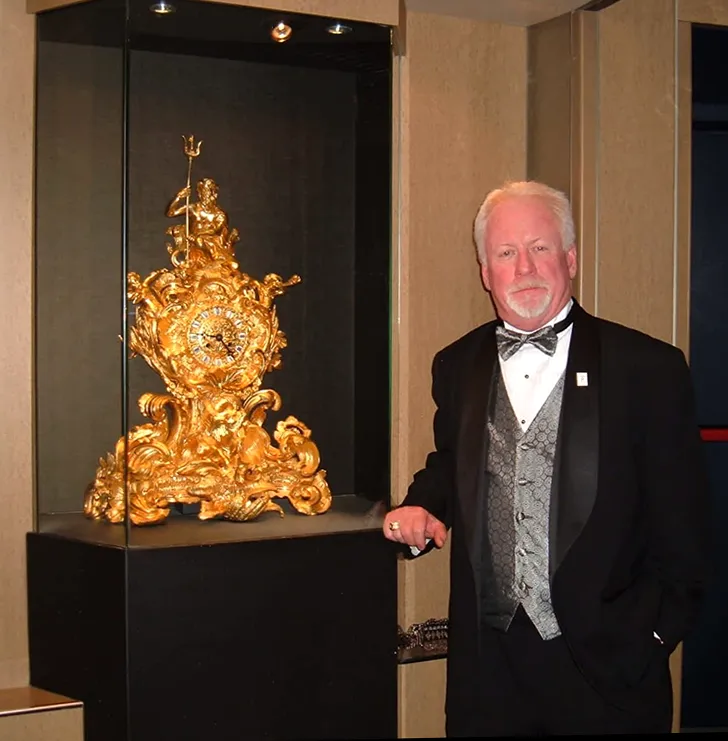
Dave Upton — Cobourg Clocks, clock repair Cobourg Ontario

Clock Repair Cobourg & Restoration Services

Repair and restoration antique clock, grandfather clocks, cuckoo clocks, quartz clocks

Cobourg Clocks services all types of clocks — antique and modern, large and small. Whether your clock has been sitting silent for years or just needs a tune-up, Dave brings decades of hands-on expertise to every repair.

We can restore your clock to original condition, including case refinishing, glass cutting, sourcing lost parts, repairing damage, and providing information regarding your clock’s origin, date of manufacture, and approximate value.

Before performing repairs, we inspect your clock to make certain it can leave our workshop problem-free. Every clock we overhaul goes through a rigorous process, ensuring every potential problem is addressed.

See our completed restorations and clocks for sale

Clock Restoration Examples by Cobourg Clocks

Before and After Restorations That Bring Clocks Back to Life

At Cobourg Clocks, every restoration tells a story. Below are just a few examples of the clock repair and restoration work Dave Upton has completed over the years — from clocks delivered in pieces to stunning finished timepieces. Whether your clock needs a simple cleaning or a complete overhaul, the results speak for themselves.

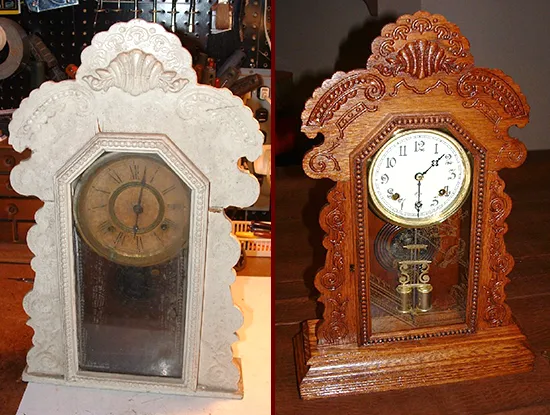
Antique American Ansonia Clock Repair before and after photo

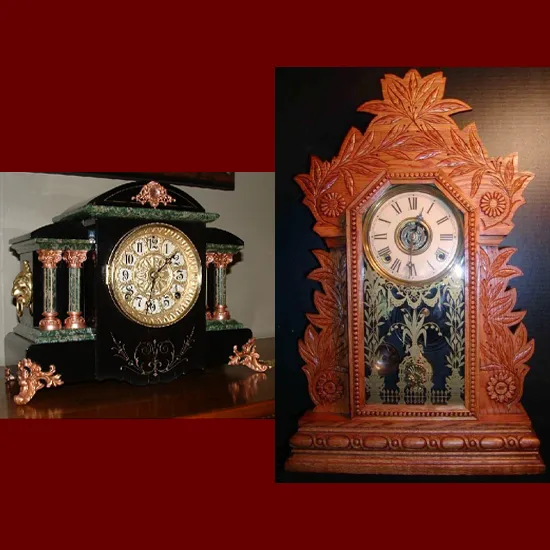
Ansonia Gingerbread Clock
Before and After: 1905 Ansonia Gingerbread Clock

Cobourg Clocks can restore your clock to original condition, including case refinishing, glass cutting, obtaining any lost parts, repairing damage, supplying proper keys, etc. and helping with information regarding your clock’s origin, date of manufacture and approximate value. This Ansonia Gingerbread clock was delivered to our shop painted white, missing its base, with a broken movement and missing parts. The result is a stunning example of a restored 1905 Gingerbread clock.

Dial Clock before and After

Case Refinishing
Before and After: Bringing Out the Original Beauty

Most clock cases suffer from years of waxing, dust and dirt, and can be refinished to bring out the clock’s original beauty as the manufacturer intended.

The Adamantine Clock Repair

Dial and Face Restoration
Before and After: Clock Dial and Face Repairs

This is an example of the Adamantine clock style showing a before and after view of the restoration. All aspects of the case, dial, metal legs, pillars and side pieces are refinished. The case is restored to original and the gold scroll work is hand finished.

1800s english longcase Clock that was repaired

1800s English Longcase Clock — Lakeport, Ontario

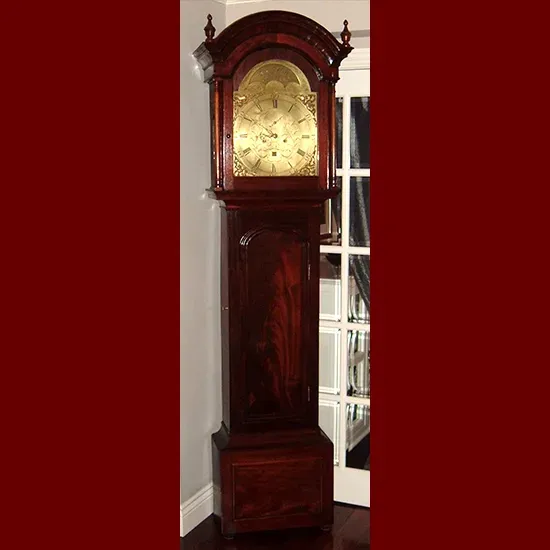
This late 1800s English Longcase clock was purchased by a customer from Waddington’s auction house in Cobourg in a sad state of disrepair, and delivered to Cobourg Clocks for restoration. The case was in pieces, the movement was broken, and it was missing parts. However, the dial, glass and several other parts were in excellent condition, and overall had great potential for restoration. The case was restored, including repair of several cracks and scratches; the dial was cleaned and polished; the movement was repaired and made fully operational. Today this beautiful clock stands proud in a century home in Lakeport, Ontario, completely restored to its original operating splendour.

Uhrenfabrik concordia eingetragene genossenschaft

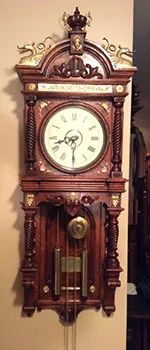
Uhrenfabrik Concordia Eingetragene Genossenschaft — A 4th Generation Family Clock

In the fall of 2013, a gentleman called and stated he had a family clock in need of repair. A large shipping box was delivered to Cobourg Clocks, and written on the box was a note stating the contents had been packed in 1970. The container was opened and the contents laid out on our workbench. This clock was in multiple pieces, with broken parts, missing trim and damaged. Over the next three months, this clock was completely restored to original condition.

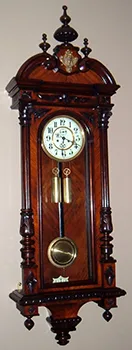
This is a Uhrenfabrik Concordia Eingetragene Genossenschaft or U.C.E.G. wall regulator clock from Freiburg in Schlesien, a former German town, now part of Poland. This company was in the clock manufacturing business from 1881 to 1899 and was then purchased by the Gustav Becker Clock Works Co. in 1899. Known as a Concordia clock, it is extremely rare as production was limited. The clock measures over 54″ high by 22″ wide.

Delivered to the family on March 16, 2014, it is a 4th generation clock, and the entire remaining family were on hand for its presentation. This clock was purchased new in Germany in 1881 by our customer’s great-grandfather, shipped to England where it remained until the 1950s when it was shipped to Canada. It was eventually packed up in 1970 and showed up at Cobourg Clocks for restoration in 2013. After a long journey, this grand old lady was restored to its present condition, giving this family many more years of enjoyment.

Appraised value on completion: $8,500.

c.1800s Scottish Longcase

c.1800s Scottish Longcase — A 230-Year-Old Family Heirloom

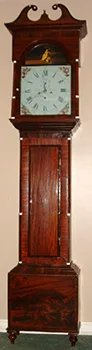
This early c.1800s Scottish Longcase clock has been owned by the same family for 6 generations in Peterborough, Ontario. The case, inlaid with ivory, was completely restored. The dial was shipped to England where it was professionally restored to original condition. The movement was cleaned, oiled and the weight spools were re-strung. A complete restoration produced this wonderful example of a 230-year-old family heirloom.

Valued at $12,000.

Sessions lighthouse banjo wall clock

Sessions Banjo Wall Clock — Third Generation Family Heirloom

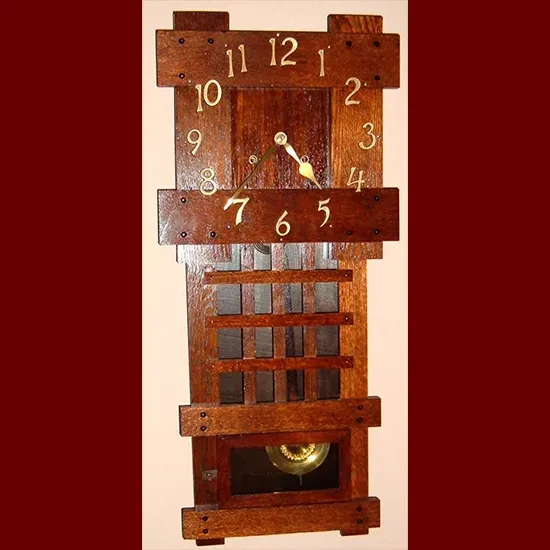
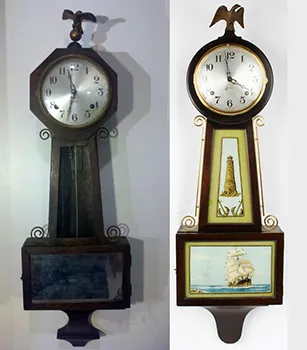
This Sessions Banjo wall clock, a third-generation family-owned heirloom, was delivered for a complete restoration. The case was completely disassembled and refinished, the dial and bezel were restored, and the movement, including broken springs, was rebuilt. The door and face glass was restored to original.

seth thomas model Paxo

Seth Thomas Model “Paxo” — c.1902 Adamantine 8-Day Shelf Clock

This Seth Thomas Model “Paxo” c.1902 adamantine 8-day shelf clock was recently restored by completely disassembling the case and cleaning and polishing each piece back to its original gloss finish. The dial was restored, along with the movement being completely overhauled. A beautiful example of a Seth Thomas shelf clock. An original Seth Thomas clock catalogue from 1904 lists the Paxo model for sale at $11.

Current restored value: $750.

1873 French grandfather clock

1873 French Grandfather Clock — Centreton, Ontario

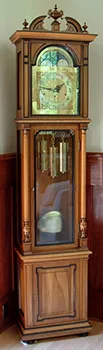
This beautiful 1873 French Grandfather Clock was recently completed by Cobourg Clocks. The clock stands an impressive 91″ high. It features a Petite Sonnerie Ting Tang striking movement with the moon dial, date and French day functions. All aspects of this clock were completely restored, including the movement, dial, weights, pendulum, new bevelled glass, and the case, which was missing some trim and the original finish. This clock now stands proud in the SS#18 Public School, Centreton, Ontario, which opened in 1857 and which has been completely renovated and restored and is now used as a private residence.

port hope fire department

Port Hope Fire Department — 1891 Waterbury Wall Regulator

In the spring of 2018, Cobourg Clocks was contacted by the Chief of the Port Hope Fire Service regarding a wall clock that was in need of restoration, having been in the possession of the Department for 125 years. This clock had been donated to the Department by a local businessman in 1893 who suffered a fire at a downtown business that he owned, in which the Port Hope Fire Department battled.

The clock was identified by Cobourg Clocks as being an 1891 Waterbury Wall Regulator, the “Augusta” model. The clock underwent a complete restoration and was presented back to the Department, where it hangs proudly in the Fire Hall today.

Antique & Restored Clocks For Sale — Cobourg Clocks

Fully Restored, Ready to Run — Each Clock a Piece of History

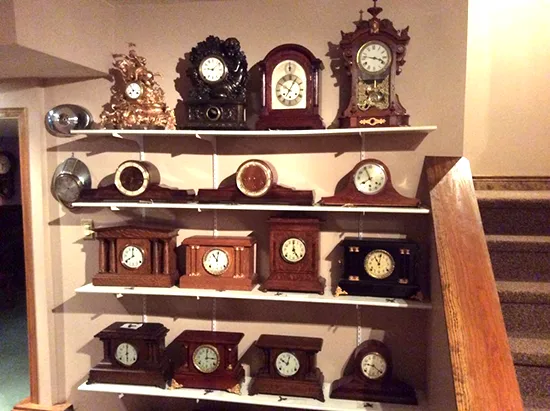
Cobourg Clocks has a carefully curated selection of antique and restored wall and shelf clocks available for sale. Every clock listed has been fully restored by Dave Upton — Cobourg’s trusted clock repair and restoration specialist — and is in excellent running condition, cleaned, serviced and ready to become part of your home.

All clocks can be purchased in person or shipped safely anywhere in Canada or the United States. To inquire about any clock listed, please contact Dave at cobourgclocks@gmail.com

Clocks for sale Ontario
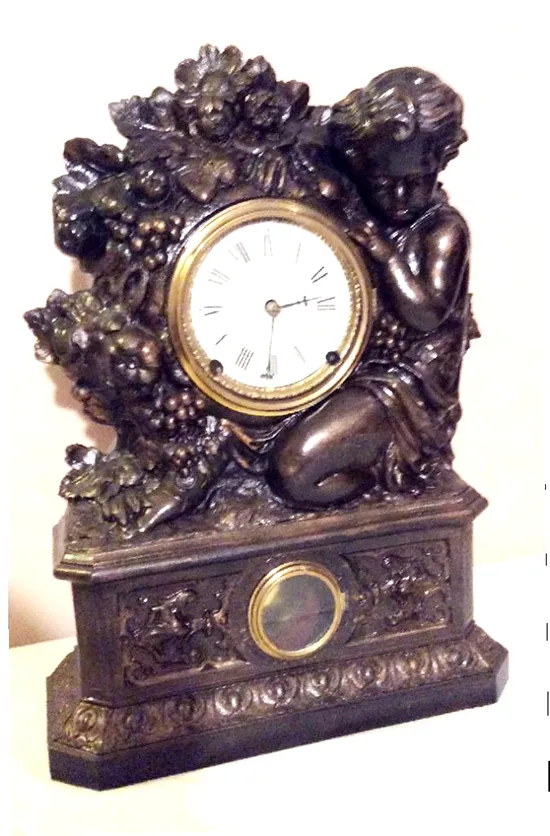
New York Style Clock

New York Clock Company
New York Clock Company — circa 1890

Very large metal front — 8-day restored clock.

Price: $1,200

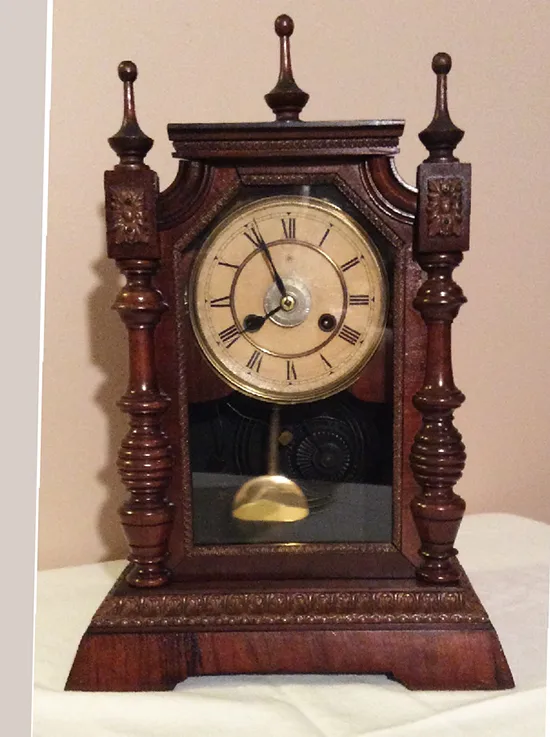
Junghans Clock, clock repair Cobourg

Junghans Clock Company
Junghans Clock Company — circa 1885

30-hour movement with alarm feature. Time only. Restored case with original dial, pendulum and movement. Recently serviced. Mahogany finish.

Price: $650

Beginnings and the History of Clocks

Humankind has always recognized the passing of time, and has tried to measure and record that passing. The simple alarm clock at your bedside table owes its existence to more than 6,000 years of thinking about time and tinkering with devices to accurately mark its passage. The history of clocks dates back over many centuries. The actual date for the first clock is disputed among historians, but they do agree that the word ‘clock’ was first used in the 14th century. The word ‘clock’ is derived from the Latin ‘clocca’ meaning bell.

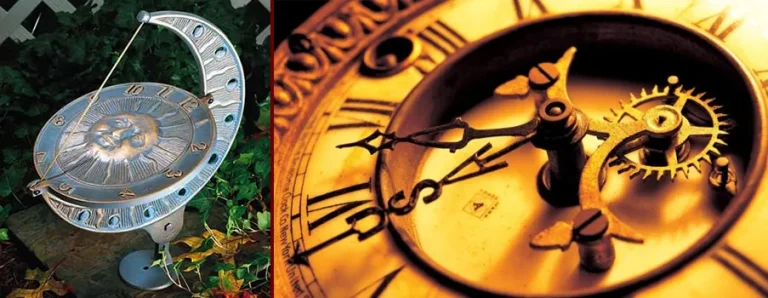
The first methods for telling the time relied on the movement of the sun across the sky. When the sun was directly overhead it was the middle of the day, or ‘noon’, and when it was on the horizon it was early morning or early evening, depending on whether it was in the east or the west. This method was not very accurate, but nevertheless it has been used for countless years, from early man right through to today.

A general knowledge of time division was relevant to the earliest farmers, who sectioned time into broad periods of seasons for planting, growing and harvesting. In those days, however, the actual hour of any particular day was not important.

As early civilizations grew and became more complex in their needs for order and governance, a more precise measure of time was required. The early Egyptians originated the division of each day into two measurable parts, using the position of an obelisk’s shadow to mark high noon. Other early and more precise timekeeping devices also include the hourglass, indexed candles that burned at a fixed rate, and water-powered devices.

History of Clocks moondial sundial gnonmon


In medieval times, the regulation of monastic calls to prayer was accomplished by means of mechanical tower clocks. This revolutionary device soon synchronized the rhythms of entire cities. Worldviews of entire cultures were influenced by the type of clocks they used. The development of atomic clocks, accurate to a billionth of a second, seems to reflect modern society’s near obsession with youth, age and the passage of time.
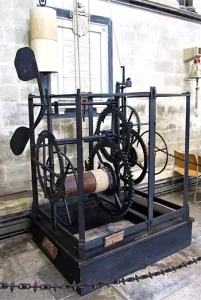
The very first early mechanical clocks, which didn’t have pendulums, were developed in the last half of the thirteenth century, probably by monks from central Europe, and were placed within the church. They did not have dials or hands and only struck bells on the hour. These mechanical devices were probably placed in the church belfry in order to make use of the existing church bell. It was over 100 years before visible dials and hands were added. These early clocks were very large and were made of heavy iron frames and gears forged by the local blacksmiths.
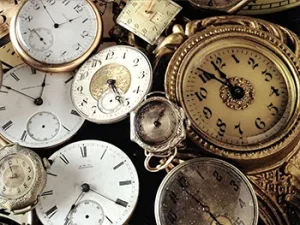
timeless old clocks

In 1580 or so, the astronomer Galileo Galilei observed a swinging lamp suspended by a long chain from a cathedral ceiling. He studied its swing and discovered that each swing was equal and had a natural rate of motion. He later found this rate of motion depended upon the length of the chain or pendulum. Many years later in 1640, he designed a clock mechanism incorporating the swing of a pendulum, but he died before building his clock design.
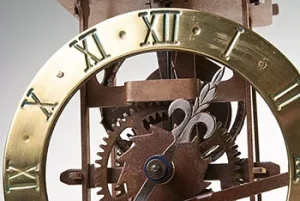
antique speed dial countdown

Later in 1656, Christiaan Huygens added a pendulum to a clock mechanism of his own design and found it kept excellent time. Regulating the speed of the movement was done, as it is today, by simply raising or lowering the pendulum bob: up, to speed up the clock; down, to slow down the clock — thus the terms ‘speed-up’ and ‘slow-down’. Note: the length of a pendulum is usually considered to be the length from the centre of the shaft that holds the hands to the centre of the pendulum bob. (Sometimes it is from the centre of the shaft that holds the hands to the bottom tip of the pendulum bob.)

Huygens’ invention allowed clocks to be accurate to as little as three minutes loss or gain per day, instead of the previous quarter to half an hour per day variance. The introduction of minute hands resulted from this increased accuracy. By 1670, with the introduction of the anchor escapement, time variance was decreased to as little as a few seconds per week.
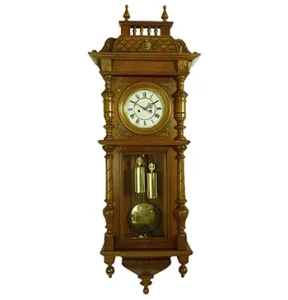
1656 christian huygens clock

By the first part of the fifteenth century, small domestic clocks started to appear. They were probably made by the local gunsmiths or locksmiths. After 1630, a weight-driven lantern clock became popular for the home use of the very wealthy. When the swinging pendulum was added in 1656, clocks became more accurate. Very early clock movements were mounted high above the floor because they required long pendulums and large cast-iron descending weights. In reality, they were nothing more than simple mechanical works with a face and hands. They were referred to as “wags-on-the-wall”. The long-case, or grandfather clock, actually evolved from these early wags-on-the-wall prototypes. Wooden cases were used only to hide the unsightly weights and cast-iron pendulum.

Although the Dutchman Huygens’ innovative pendulum design brought a great leap forward in clockmaking, it was English clockmakers who reigned supreme in Europe from about 1660 to the early 19th century, when the Americans introduced inexpensive brass movements.
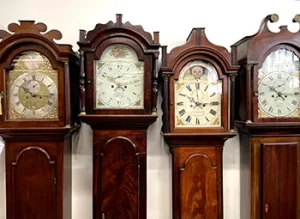
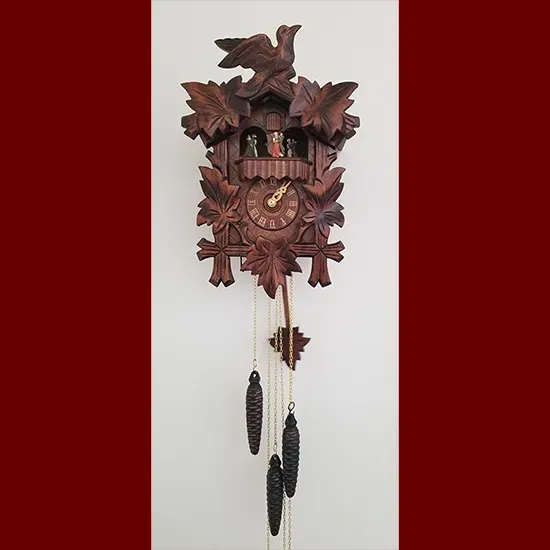
Grandfather Clock

Clock Repair Testimonials

Nothing makes us happier than a clock that’s ticking again — except perhaps hearing from the happy owner! Here are some kind words from customers across Ontario who trusted Cobourg Clocks for their clock repair and restoration needs in Cobourg and beyond.

905-377-9412

cobourgclocks@gmail.com

1000 Glenhare Street,
Cobourg, ON

Dave and Maggie Upton, of Cobourg Clock, clock repair in Cobourg Ontario

Dave and Maggie Upton

Dave Upton is Cobourg’s clock repair craftsman — passionate about preserving the timepieces that matter most to you. Dave and Maggie welcome your call! If it won’t tick, let Dave tock to it! Reach out today for an honest assessment and a fair price.

Send Dave a Message

Terms of Sale & Shipping Information, Clock Repair, Cobourg

All clocks listed for sale can be purchased in person or shipped safely anywhere in Canada or the United States. Whether you’re in Cobourg or across Ontario, Dave Upton’s clock repair and restoration expertise ensures every clock leaving our workshop is in excellent running condition. To inquire about any clock listed, please contact Cobourg Clocks at cobourgclocks@gmail.com

Payment: We accept Cash, Cheques and e-Transfers.

Shipping: Cobourg Clocks has shipped clocks worldwide for years. Each clock is carefully packed and sent through Canada Post.

Canada — Xpresspost: 2–3 days with a tracking number

United States — Expedited Parcel USA: 7–10 day delivery. Tracking number in Canada only.

Please Note: All shipping costs are the responsibility of the buyer. All postage will be prepaid to Cobourg Clocks prior to shipping. Any duty, taxes, brokerage fees or additional costs to countries outside of Canada are the sole responsibility of the buyer.